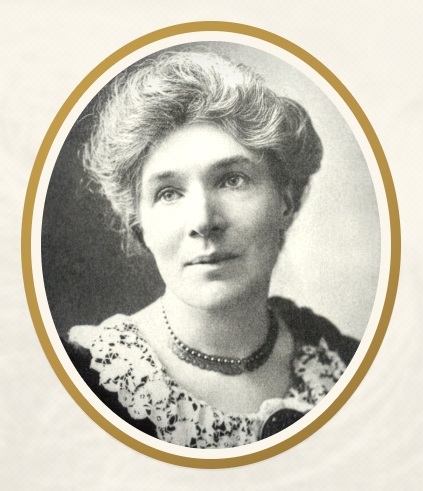
"My Hopekirk Connections" by Benedict Jan Kolczyński


Hannah Roberts, Benedict Kolczyński, Veronika Strelbitskaia (May, 2026)
"Is Mrs Hopekirk indoors?" my mother asked the gardener, who gave an affirmative reply. "Who is Mrs Hopekirk?" I asked with a small child's curiosity. It was the first time I had heard the name. "It's Grandmama!" she replied.
It was 1954 and I was aged 3, on my first visit to England, having been born in Durban, South Africa, in 1951. My parents Christine and Adam Kolczyński, and grandmother Margaret, were all in Sussex in south-east England for a stay of several months. My parents had rented part of a large farmhouse, while Grandmama, as I will now call her, had found other accommodation not far away.
Many years later I began researching, with the help of the internet, the origins of the surnames in my immediate family: Kolczyński, Hoon, Perceval, and - Hopekirk. I was interested to find a reference to Edinburgh-born pianist and composer Helen Hopekirk, and wondered if there might be any family link with my maternal great-grandmother Frances Margaret Hopekirk, who had also been raised in the Scottish capital in the 19th century.
I found a site dedicated to the history of families with similar surnames (Hopkirk, the commonest, also Hobkirk, Habkirk, and the apparently rare variant Hopekirk). I contacted the compiler, one John Hopkirk, and he indicated that there was indeed such a family link, with Helen and Frances Margaret having been first cousins. Thiswas subsequently confirmed by Gary Steigerwalt in correspondence with me in 2026.
My curiosity also impelled me, in 2017,to make a trip to the small village of Hobkirk, at one time also known as Hopekirk and the probable source of the surname, in the Scottish Borders, south of Hawick and close to Bonchester Bridge. I can imagine that the hilly, if picturesque, local terrain made it hard for the bygone inhabitants to make a living from farming. Hence no doubt their dispersal and migration to centres such as Edinburgh.
My mother Christine Carlotta (1912-2002) was the only child of Grandmama Margaret (1882-1956) and my grandfather Lawrence William Hoon(1880-1961), a broker on the Johannesburg Stock Exchange. Although born in London, she was taken to South Africa at a very early age and grew up there, among other things studying for a time at the University of Cape Town. Grandmama herself was one of four children of Frances Margaret and John Perceval, a businessman originally, I think, from Hampshire, though the family lived in the Reading area and later near Malvern in Worcestershire.
Frances Margaret (1846-1913), one of numerous children of Robert Craigie Hopekirk (1809-1868), Helen's uncle, grew up in Edinburgh under the care of two aunts although records indicate that she was born in England, Robert Craigie having migrated south and established a business in Exeter. It seems the family must have undergone some crisis for this arrangement, so far north, to become necessary. By the time she was grown up she had apparently already attracted the attention of numerous male admirers in Edinburgh but had turned them all down. One is reputed to have said: "She carries too many guns for me"!
Although Frances Margaret was a first cousin of Helen, I have no information as to the degree of contact between them. Their fathers Robert Craigie and Adam (1826-1876) were separated not only by geographical distance but also by age difference. However, although Frances Margaret moved south again once grown up, and married an Englishman, she apparently continued to take pride in her Scots heritage, including a breakfast-time practice of salting her oatmeal porridge or brose!
A photo of Frances Margaret, dated 13th September 1877, shows her leaning on a cabinet or similar item of furniture, with arms folded and eyes demurely lowered. The occasion is unknown, but I imagine it was taken not long before her marriage to John Perceval.
Their four children were named Maurice, Margaret, Samuel, and Frances. Samuel unfortunately died in infancy after a fall from a pram. Their father also died while the children were fairly young. A family friend, self-styled "Cousin Jimmy" took on the role of financial adviser to their mother. However, he turned out to be a scoundrel and embezzled a substantial proportion of her assets.
This meant that very soon after leaving school at around 18 Maurice, Margaret ("Madge"), and Frances ("Robin") all had to find ways of earning their living. Maurice emigrated to South Africa intending to study agriculture and become a farmer. Soon after his arrival there the Anglo-Boer War broke out and he joined the British forces as a trooper in the South African Light Horse, a cavalry regiment, eventually gaining the rank of lieutenant. Among the people he met during that time was the young Winston Churchill, then a war correspondent.
The two sisters found positions as English-teaching governesses in Continental Europe - Frances in southern France, Margaret in Germany, each staying for around two years (two and a half in Margaret's case).
Margaret first went in 1899, aged 18, to a family in Hamburg. Her main duties involved teaching English to the seven-year-old son of the house. Additionally, she was required to supervise his daily violin practice - the parents were ambitious for him to pursue a musical career. Now Margaret was herself musical and, like many young women of her background at that time, played the piano (perhaps inspired by stories of Helen?), so she thought this should not be too onerous. She was wrong!
Unknown to her, the ambitious parents had developed a habit of listening through the keyhole of the music-room. Margaret was taken by surprise during the first practice session when, after the boy had played a wrong note, the parents flung wide the door and stormed in, telling the boy he would never make it as a violinist at that rate. The poor child promptly burst into tears. To Margaret's surprise, so then did the parents, hugging their son and reassuring him. That, however, was not the end. The process was repeated almost daily, and after a time she decided that she had had enough and looked for a position elsewhere.
She found one much further to the east - in what was then East Prussia (Ostpreussen). Her new employers were the young landowning von Migge family living on an estate called Sperlings near the village of Troempau, to the north of Koenigsberg/Królewiec (now Kaliningrad). I remember her telling me how she had been met at the nearest railway station by their coachman, driving a horse-drawn sleigh as it was winter.
Her time there seems to have been a happy one. Among other things the family took her with them on holiday to the Baltic resort of Sopot, now in Poland. I still have letters and postcards she received during that period from her brother in South Africa and her employers' friends and relatives, some of whom addressed her as "unsere Miss". When she returned to England she was fluent in German, and for the rest of her life always related easily to German speakers. However, the actions of the German state in the two World Wars, so my mother told me, came as a great disappointment to her.
By the time of her return the South African war was over and her brother Maurice had left the army and become a mining engineer in Johannesburg. He was visited on more than one occasion by his mother and also by Margaret herself. It was on one of these occasions that Margaret first met her future husband Lawrence Hoon, who was an acquaintance of Maurice's. Until 1908, when they married, the two Perceval sisters and their mother Frances Margaret rented a cottage in the Sussex village of Coleman's Hatch, near Ashdown Forest (of Winnie-the-Pooh fame).
Lawrence had been born in London, one of a large and not very well-off family, possibly of Flemish descent. He had left school at thirteen and a half (as he always proudly recounted in later life!) and worked for some time as an office-boy in, I think, an import-export firm in London's Docklands. Then he, too, emigrated to South Africa, where he found a job near Durban, representing a wholesaler supplying village and small town stores with loose goods such as flour, salt, sugar, tea, and coffee.
First of all, though, he had to learn to ride a horse, on which he would then make a monthly round of the company's clients to collect orders for fresh supplies. However, although this no doubt improved his knowledge of local geography, the journeys had to be undertaken in all kinds of weather including extreme heat and heavy rainfall. So after some time he moved up-country to Johannesburg and in due course became a stock-broker there.
It appears, from my mother's reminiscences, that Frances Margaret did not altogether approve of Lawrence as a suitor for her elder daughter's hand. As things turned out later, maybe she had some justification. Nevertheless, they were married in 1908 in the Anglican Cathedral in Cape Town. My mother Christine was born during a stay in London in 1912, a year before Frances Margaret's death. The newlyweds settled in Johannesburg and had a house built in one of the suburbs.
For the first few years things went well, with Lawrence's business prospering, though the First World War cast a shadow. Grandmama had several friends of German origin in Johannes-burg, and these were interned for the duration as "enemy aliens". Also Maurice, who was working in West Africa when the War broke out in 1914, rejoined the army but was soon killed in an engagement with German forces in Cameroon, part of which was then a German colony.
In the home at that time there was quite a lot of music-making. Grandmama had acquired a "baby grand" piano, and in the evenings she would accompany Lawrence as he sang arias from operettas and other light material. He had a strong singing voice, and I remember his renditions, in the 1950s, of music-hall numbers with lyrics like:
"Lottie Collins had no sense/She bought a fiddle for 18 pence/And the only tune that she could play/Was tara-ra-ra boom-di-ay!"
Or: "Has anyone seen the moving lot, the ones I want to find/There's a couple of kids a-hauling on a rope and an old girl hanging on behind./Now it takes a lot of luck/And it wants a lot of pluck/To be always shooting the Moon!" (running away without paying the rent - B.K.).
I also remember his loud singing in church - which apparently embarrassed Christine when she was a girl!
For some reason, after a few years, things started to go wrong between my grandparents. According to my mother, Lawrence began seeking the company and admiration of other ladies, some of them perhaps impressed by his tales of service behind the front lines as an ambulance driver with the French Red Cross during the recent War. But I suspect that there may have been irreconcilable differences in their respective world-views.
Grandfather was much more conservative and colonialist in terms of his attitude to the country's indigenous inhabitants, whom he perceived exclusively from an employer's point of view. He also had conservative opinions on the advancement of women. This showed itself in his refusal to finance Christine's higher education for the full duration of the speech and drama course which she really wanted to follow. There was also the factor of his own education background, having left school much earlier than Margaret. Maybe he felt himself not to be her equal in this regard.
Grandmama, by contrast, was a strong supporter of both higher education and voting rights for women. Also, she viewed indigenousAfricans much more as people than did her husband. This showed itself in the relationship she had with the Basotho nannyElizabeth Mkudle, whom they had employed to help look after Christine. Elizabeth was, for an African woman in the first quarter of the 20th century, exceptionally well-educated and fluent in English. Grandmama and she operated much more as a team than as mistress and servant. Altogether Elizabeth was with them for ten years.
The tensions between my grandparents led eventually to a divorce, and Grandmama had to function as a single parent, though with loyal support and assistance from Elizabeth. By that time Grandmama had decided that she did not wish to retain her married surname of Hoon. Very likely as a tribute to her own mother Frances Margaret, she officially became known as "Mrs Hopekirk", and used this name right up to her death in 1956.
As I have mentioned, Maurice Perceval had been killed in Cameroon early in World War I. He was unmarried and had no children. That conflict affected the family in general. The husband of Frances ("Aunt Robin") was seriously wounded on the Western Front and remained semi-invalid for the rest of his life. They also had no children. Two cousins who had grown up in Australia fell during the military operation at Gallipoli. So Christine was not just anonly child but the only child during those years.
Grandfather later remarried. He and his second wife had a son who was considerably younger than Christine. They lived in a largehouse which had been built for them not far from Durban. I remember visiting this house on a number of occa-sions, and Grandfather was always hospitable. However, after he died my parents and I gradually lost touch withthe Hoons. Although he had three other grandchildren I have no idea where they are.
Grandmama Hopekirk stands out in my memory as a slim, upright figure with snow-white hair and a ready smile, always willing to read to me, tell stories, or accompany me on walks. Sadly, I only knew her until I was aged 5. She died peacefully of a suspected brain tumour in 1956, aged only 74. How much more I would have learned from her if she had been with us for longer.
Her international outlook, for she had friends of many nationalities, had surely been formed during her time in East Prussia as a young woman. She passed this on to Christine, who was similarly open to all such contacts, to the extent that she married a Polish national - my father Adam (1915-1971) who had served as an airman in Poland, France, and Britain during World War II and remained in the West afterwards. She was widely-travelled, as also was Adam - a Polish farmer's ambitious son who learned to fly and later qualified as a lawyer. In fact Christine's first direct contacts with Continental Europe, including Poland, were during a student group trip from various South African universities (though indigenous Africans were not among the participants).
I feel privileged to have known and been brought up by this trio of remarkable people.
As I have mentioned earlier, I was born in Durban in 1951 and had some schooling there, but in 1960 we moved as a family to the United Kingdom in view of the deteriorating political situation in South Africa. I completed my education in England, specialising in foreign languages - Russian, German, and Polish - while at university and afterwards, and gaining teaching qualifications.
My working life has involved, among other things, language teaching, tourist guiding, and processing of agricultural science information from international sources. I retired in 2016 and now devote much of my time to music on stringed instruments in a range of contexts, including a folk band, a church music ensemble, and informal playing (mainly of traditional material from the British Isles) in cafes and public spaces.
It was 1954 and I was aged 3, on my first visit to England, having been born in Durban, South Africa, in 1951. My parents Christine and Adam Kolczyński, and grandmother Margaret, were all in Sussex in south-east England for a stay of several months. My parents had rented part of a large farmhouse, while Grandmama, as I will now call her, had found other accommodation not far away.
Many years later I began researching, with the help of the internet, the origins of the surnames in my immediate family: Kolczyński, Hoon, Perceval, and - Hopekirk. I was interested to find a reference to Edinburgh-born pianist and composer Helen Hopekirk, and wondered if there might be any family link with my maternal great-grandmother Frances Margaret Hopekirk, who had also been raised in the Scottish capital in the 19th century.
I found a site dedicated to the history of families with similar surnames (Hopkirk, the commonest, also Hobkirk, Habkirk, and the apparently rare variant Hopekirk). I contacted the compiler, one John Hopkirk, and he indicated that there was indeed such a family link, with Helen and Frances Margaret having been first cousins. Thiswas subsequently confirmed by Gary Steigerwalt in correspondence with me in 2026.
My curiosity also impelled me, in 2017,to make a trip to the small village of Hobkirk, at one time also known as Hopekirk and the probable source of the surname, in the Scottish Borders, south of Hawick and close to Bonchester Bridge. I can imagine that the hilly, if picturesque, local terrain made it hard for the bygone inhabitants to make a living from farming. Hence no doubt their dispersal and migration to centres such as Edinburgh.
My mother Christine Carlotta (1912-2002) was the only child of Grandmama Margaret (1882-1956) and my grandfather Lawrence William Hoon(1880-1961), a broker on the Johannesburg Stock Exchange. Although born in London, she was taken to South Africa at a very early age and grew up there, among other things studying for a time at the University of Cape Town. Grandmama herself was one of four children of Frances Margaret and John Perceval, a businessman originally, I think, from Hampshire, though the family lived in the Reading area and later near Malvern in Worcestershire.
Frances Margaret (1846-1913), one of numerous children of Robert Craigie Hopekirk (1809-1868), Helen's uncle, grew up in Edinburgh under the care of two aunts although records indicate that she was born in England, Robert Craigie having migrated south and established a business in Exeter. It seems the family must have undergone some crisis for this arrangement, so far north, to become necessary. By the time she was grown up she had apparently already attracted the attention of numerous male admirers in Edinburgh but had turned them all down. One is reputed to have said: "She carries too many guns for me"!
Although Frances Margaret was a first cousin of Helen, I have no information as to the degree of contact between them. Their fathers Robert Craigie and Adam (1826-1876) were separated not only by geographical distance but also by age difference. However, although Frances Margaret moved south again once grown up, and married an Englishman, she apparently continued to take pride in her Scots heritage, including a breakfast-time practice of salting her oatmeal porridge or brose!
A photo of Frances Margaret, dated 13th September 1877, shows her leaning on a cabinet or similar item of furniture, with arms folded and eyes demurely lowered. The occasion is unknown, but I imagine it was taken not long before her marriage to John Perceval.
Their four children were named Maurice, Margaret, Samuel, and Frances. Samuel unfortunately died in infancy after a fall from a pram. Their father also died while the children were fairly young. A family friend, self-styled "Cousin Jimmy" took on the role of financial adviser to their mother. However, he turned out to be a scoundrel and embezzled a substantial proportion of her assets.
This meant that very soon after leaving school at around 18 Maurice, Margaret ("Madge"), and Frances ("Robin") all had to find ways of earning their living. Maurice emigrated to South Africa intending to study agriculture and become a farmer. Soon after his arrival there the Anglo-Boer War broke out and he joined the British forces as a trooper in the South African Light Horse, a cavalry regiment, eventually gaining the rank of lieutenant. Among the people he met during that time was the young Winston Churchill, then a war correspondent.
The two sisters found positions as English-teaching governesses in Continental Europe - Frances in southern France, Margaret in Germany, each staying for around two years (two and a half in Margaret's case).
Margaret first went in 1899, aged 18, to a family in Hamburg. Her main duties involved teaching English to the seven-year-old son of the house. Additionally, she was required to supervise his daily violin practice - the parents were ambitious for him to pursue a musical career. Now Margaret was herself musical and, like many young women of her background at that time, played the piano (perhaps inspired by stories of Helen?), so she thought this should not be too onerous. She was wrong!
Unknown to her, the ambitious parents had developed a habit of listening through the keyhole of the music-room. Margaret was taken by surprise during the first practice session when, after the boy had played a wrong note, the parents flung wide the door and stormed in, telling the boy he would never make it as a violinist at that rate. The poor child promptly burst into tears. To Margaret's surprise, so then did the parents, hugging their son and reassuring him. That, however, was not the end. The process was repeated almost daily, and after a time she decided that she had had enough and looked for a position elsewhere.
She found one much further to the east - in what was then East Prussia (Ostpreussen). Her new employers were the young landowning von Migge family living on an estate called Sperlings near the village of Troempau, to the north of Koenigsberg/Królewiec (now Kaliningrad). I remember her telling me how she had been met at the nearest railway station by their coachman, driving a horse-drawn sleigh as it was winter.
Her time there seems to have been a happy one. Among other things the family took her with them on holiday to the Baltic resort of Sopot, now in Poland. I still have letters and postcards she received during that period from her brother in South Africa and her employers' friends and relatives, some of whom addressed her as "unsere Miss". When she returned to England she was fluent in German, and for the rest of her life always related easily to German speakers. However, the actions of the German state in the two World Wars, so my mother told me, came as a great disappointment to her.
By the time of her return the South African war was over and her brother Maurice had left the army and become a mining engineer in Johannesburg. He was visited on more than one occasion by his mother and also by Margaret herself. It was on one of these occasions that Margaret first met her future husband Lawrence Hoon, who was an acquaintance of Maurice's. Until 1908, when they married, the two Perceval sisters and their mother Frances Margaret rented a cottage in the Sussex village of Coleman's Hatch, near Ashdown Forest (of Winnie-the-Pooh fame).
Lawrence had been born in London, one of a large and not very well-off family, possibly of Flemish descent. He had left school at thirteen and a half (as he always proudly recounted in later life!) and worked for some time as an office-boy in, I think, an import-export firm in London's Docklands. Then he, too, emigrated to South Africa, where he found a job near Durban, representing a wholesaler supplying village and small town stores with loose goods such as flour, salt, sugar, tea, and coffee.
First of all, though, he had to learn to ride a horse, on which he would then make a monthly round of the company's clients to collect orders for fresh supplies. However, although this no doubt improved his knowledge of local geography, the journeys had to be undertaken in all kinds of weather including extreme heat and heavy rainfall. So after some time he moved up-country to Johannesburg and in due course became a stock-broker there.
It appears, from my mother's reminiscences, that Frances Margaret did not altogether approve of Lawrence as a suitor for her elder daughter's hand. As things turned out later, maybe she had some justification. Nevertheless, they were married in 1908 in the Anglican Cathedral in Cape Town. My mother Christine was born during a stay in London in 1912, a year before Frances Margaret's death. The newlyweds settled in Johannesburg and had a house built in one of the suburbs.
For the first few years things went well, with Lawrence's business prospering, though the First World War cast a shadow. Grandmama had several friends of German origin in Johannes-burg, and these were interned for the duration as "enemy aliens". Also Maurice, who was working in West Africa when the War broke out in 1914, rejoined the army but was soon killed in an engagement with German forces in Cameroon, part of which was then a German colony.
In the home at that time there was quite a lot of music-making. Grandmama had acquired a "baby grand" piano, and in the evenings she would accompany Lawrence as he sang arias from operettas and other light material. He had a strong singing voice, and I remember his renditions, in the 1950s, of music-hall numbers with lyrics like:
"Lottie Collins had no sense/She bought a fiddle for 18 pence/And the only tune that she could play/Was tara-ra-ra boom-di-ay!"
Or: "Has anyone seen the moving lot, the ones I want to find/There's a couple of kids a-hauling on a rope and an old girl hanging on behind./Now it takes a lot of luck/And it wants a lot of pluck/To be always shooting the Moon!" (running away without paying the rent - B.K.).
I also remember his loud singing in church - which apparently embarrassed Christine when she was a girl!
For some reason, after a few years, things started to go wrong between my grandparents. According to my mother, Lawrence began seeking the company and admiration of other ladies, some of them perhaps impressed by his tales of service behind the front lines as an ambulance driver with the French Red Cross during the recent War. But I suspect that there may have been irreconcilable differences in their respective world-views.
Grandfather was much more conservative and colonialist in terms of his attitude to the country's indigenous inhabitants, whom he perceived exclusively from an employer's point of view. He also had conservative opinions on the advancement of women. This showed itself in his refusal to finance Christine's higher education for the full duration of the speech and drama course which she really wanted to follow. There was also the factor of his own education background, having left school much earlier than Margaret. Maybe he felt himself not to be her equal in this regard.
Grandmama, by contrast, was a strong supporter of both higher education and voting rights for women. Also, she viewed indigenousAfricans much more as people than did her husband. This showed itself in the relationship she had with the Basotho nannyElizabeth Mkudle, whom they had employed to help look after Christine. Elizabeth was, for an African woman in the first quarter of the 20th century, exceptionally well-educated and fluent in English. Grandmama and she operated much more as a team than as mistress and servant. Altogether Elizabeth was with them for ten years.
The tensions between my grandparents led eventually to a divorce, and Grandmama had to function as a single parent, though with loyal support and assistance from Elizabeth. By that time Grandmama had decided that she did not wish to retain her married surname of Hoon. Very likely as a tribute to her own mother Frances Margaret, she officially became known as "Mrs Hopekirk", and used this name right up to her death in 1956.
As I have mentioned, Maurice Perceval had been killed in Cameroon early in World War I. He was unmarried and had no children. That conflict affected the family in general. The husband of Frances ("Aunt Robin") was seriously wounded on the Western Front and remained semi-invalid for the rest of his life. They also had no children. Two cousins who had grown up in Australia fell during the military operation at Gallipoli. So Christine was not just anonly child but the only child during those years.
Grandfather later remarried. He and his second wife had a son who was considerably younger than Christine. They lived in a largehouse which had been built for them not far from Durban. I remember visiting this house on a number of occa-sions, and Grandfather was always hospitable. However, after he died my parents and I gradually lost touch withthe Hoons. Although he had three other grandchildren I have no idea where they are.
Grandmama Hopekirk stands out in my memory as a slim, upright figure with snow-white hair and a ready smile, always willing to read to me, tell stories, or accompany me on walks. Sadly, I only knew her until I was aged 5. She died peacefully of a suspected brain tumour in 1956, aged only 74. How much more I would have learned from her if she had been with us for longer.
Her international outlook, for she had friends of many nationalities, had surely been formed during her time in East Prussia as a young woman. She passed this on to Christine, who was similarly open to all such contacts, to the extent that she married a Polish national - my father Adam (1915-1971) who had served as an airman in Poland, France, and Britain during World War II and remained in the West afterwards. She was widely-travelled, as also was Adam - a Polish farmer's ambitious son who learned to fly and later qualified as a lawyer. In fact Christine's first direct contacts with Continental Europe, including Poland, were during a student group trip from various South African universities (though indigenous Africans were not among the participants).
I feel privileged to have known and been brought up by this trio of remarkable people.
As I have mentioned earlier, I was born in Durban in 1951 and had some schooling there, but in 1960 we moved as a family to the United Kingdom in view of the deteriorating political situation in South Africa. I completed my education in England, specialising in foreign languages - Russian, German, and Polish - while at university and afterwards, and gaining teaching qualifications.
My working life has involved, among other things, language teaching, tourist guiding, and processing of agricultural science information from international sources. I retired in 2016 and now devote much of my time to music on stringed instruments in a range of contexts, including a folk band, a church music ensemble, and informal playing (mainly of traditional material from the British Isles) in cafes and public spaces.
My spouse Marta, an English specialist, and I moved in 2004 from the UK to Poland, where we have worked as teachers of the language in higher education and industry in the north-eastern region of Warmia-Mazury, and now live in a village south of the province's capital, Olsztyn, which is Marta's home town. Marta is an enthusiastic choral singer.